
Graphitization and Pre-Carbonization Crucible Filling
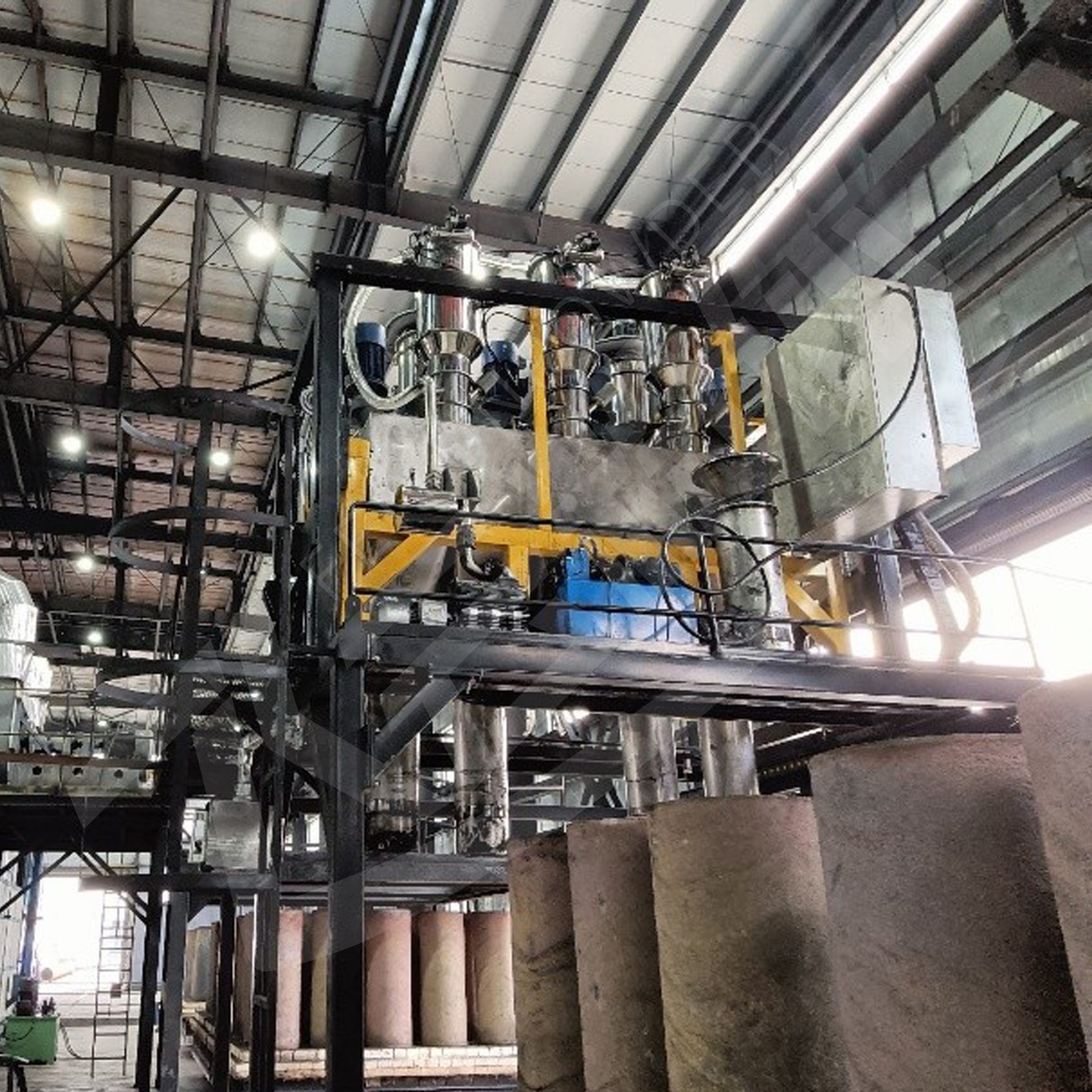
The crucible feeding system, as a core equipment in modern industrial production, significantly enhances production efficiency and safety through three major functions: high-density filling, dust control, and automated continuous operation. Its key technologies include pneumatic conveying, deaeration vibration compaction (tap density up to 90%), enclosed structure with dust removal design (dust concentration reduced by over 50%), and PLC intelligent control. It is widely used in industries such as lithium battery anode materials and photovoltaic monocrystalline silicon.
Material is fed from the bulk bag unloading station into the buffer silo below. The bag-clamping device of the unloading station ensures a relatively enclosed environment during feeding, preventing dust escape. The material is then conveyed via a negative pressure conveying system to the buffer silo for crucible feeding. Through multiple actions such as screw conveying, vacuum deaeration, and vibration, the material achieves high-density filling of the crucible. Equipped with walking and lifting mechanisms, the system enables automatic row-by-row feeding or simultaneous multi-row feeding.
Product Advantages:
Efficiency Improvement: Fully automated conveying increases efficiency by 3–5 times compared to manual feeding, with a single system capacity reaching 2–4 tons/hour.
Quality Optimization: Material density increases by over 15% after deaeration, crucible loading capacity improves, and unit energy consumption decreases by 8%–12%.
Environmental Compliance: Fully enclosed pipelines combined with a dust removal system keep workshop dust concentration ≤1 mg/m³, well below the OSHA limit of 5 mg/m³.
Loss Control: Material residual rate <0.5%, saving hundreds of thousands of yuan annually in raw material costs (based on a 10,000-ton production line). Flexible Adaptation: Modular design accommodates different crucible sizes (Φ400–600 mm) and supports parallel layout for multiple production lines.